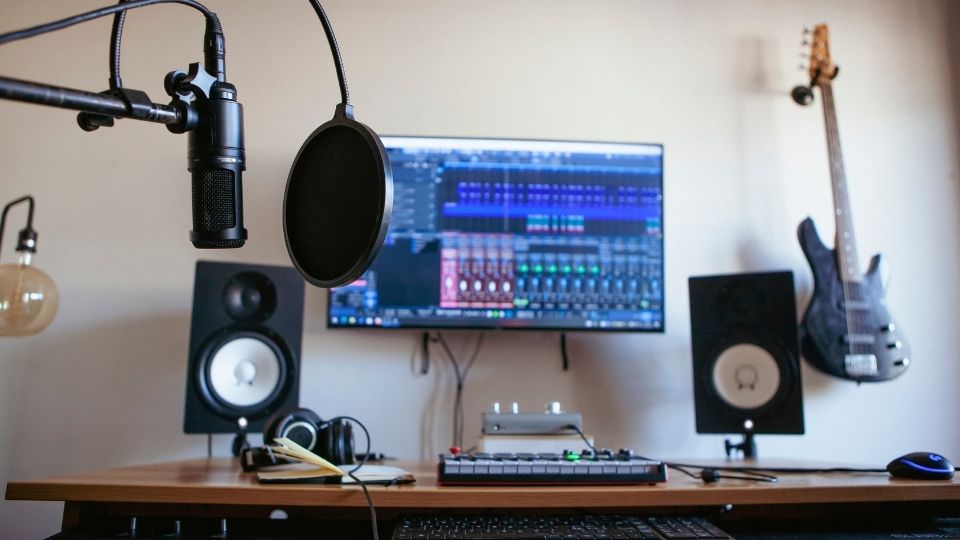

While a basic setup will allow you to record demos—and even a debut album given time & practice—it does have its limitations. Chief among them is the ability to collaborate remotely with other musicians.
It’s common practice in today’s digital environment to collaborate online, especially as a freelancer. There are even websites like soundbetter.com which give musicians a side gig recording for other people.
Many producers often work with remote freelancers, but only if they have the infrastructure to manage the request. Producers tend to want very specific things… both in terms of the music and its format. In order to (quickly) accommodate their request (and get on the shortlist for repeat requests) you’ll need to have the software & tools they’re using. And know how to use them.
javascript:void(null);
So once you have your ‘bedroom’ studio up and running, here are some next steps you can take to get to the next level.
Space To Create

Set up a dedicated space for recording:
At this stage of your recording studio, it’s no longer appropriate to have your set-up confined to a small space next to your bed. You’re going to want another room, complete with a desk, ergonomic chair, and space for your gear. It also means adding acoustic treatment ($50-300) which includes bass traps, acoustic panels, & diffuser stands. If you’re in a smaller space, you can also add reflection filters to give your vocals space when you record.
Professional Software
Pro Tools ($600/$25/month): Up to this point, you may have been using freeware for your DAW, or another alternative. Now is the time to learn Pro Tools, and learn it well, shortcuts and all. While it may seem a hefty price if you’ve been making do with freeware, Pro Tools is the industry standard, used in every professional studio. When everyone uses the same program, it's much easier to transfer files. It also comes with a number of plugins & mixing tools of a far higher standard than freeware, giving your music a more polished sound. Learning the ins and outs of ProTools can also give you a leg up if you choose to freelance as an audio engineer for local studios.
Can You Hear Me Now?
Expand your microphone collection ($300-$5000):
Not all instruments have the same sound profile. That’s partly why so many different microphones exist. In order to get the desired sound from each instrument, you need to have the right mic. This is especially important when contributing to other projects so you can replicate the right sound.
But knowing which mics your co-writers are using is even more important. If you aren’t able to acquire the same microphone, finding one of the same type and with a similar frequency response is essential.
Mics product sounds using two different means: Condenser and Dynamic:
Reproduces sound through the interaction of a thin membrane that moves with soundwaves relative to a metal plate. Requires external power. Examples:
- AKG C414 $1000
- Neumann U87 $3000
- Rode NT5 $375
- MXLv69 $200 (large diaphragm tube)
- Shure Beta87a $150
- Audio Technica 2020 $100
Reproduces sound by converting electrical signals via electromagnetic induction. Most commonly uses a moving coil. No external power required. Examples:
- Shure SM7B $400
- Electrovoice RE20 $450
- Sennheiser 421 $300
- Ribbon mics are a type of dynamic microphone which use a narrow strip of aluminum foil. The most common industry standard is the Royer 121, for $1300.
- Note: Make absolutely sure to turn phantom power off when you plug these in or you could risk frying the ribbon.
In addition to price, other specs that factor into your choice of mic include polar pattern, dynamic range, and impedance.
What These Mean:
- Polar Pattern: This is the directionality of your mic. In other words: what sounds it captures around it. This general area will affect how much of the room/atmosphere you capture in your recording.
- Cardioid: A heart-shape which captures sound directly in front of the mic, but blocks all other sides. Most common, especially for vocals.
- Hyper/Super-Cardioid: Variations on the common cardioid pattern, but tighter at the front.
- Figure 8 (AKA bidirectional): pick up equal sound from front & rear of mic, but not from sides
- Omnidirecitonal: This picks up equal sound from all directions. Result is natural & realistic to the space.
- Dynamic Range: the lowest & highest dB level any particular microphone can record. This is directly linked to its sensitivity.
- Impedance: AC resistance directly linked to how far sound can travel via cables without sound degradation. A low output impedance is best to avoid this, with your load impedance at least 5X higher to avoid distortion.
Go Virtual
Invest in virtual instruments & sample packs ($200-600):
Once upon a time, if you wanted to record with a specific instrument, you needed to own it. You needed to know how to play it (or have someone to play it for you), and set up your microphones accordingly.
Now, this work is done for you by companies who’ve recorded every note these instruments make, in various atmospheres, volumes, etc. All you have to do is click a button to select your sonic landscape and start composing.
Investing in virtual instruments or samples will allow you to record instruments that you (or you collaborator) don’t own. But they aren’t inexpensive. The more authentic the desired result, the more expensive the solution, as it takes longer for the virtual instrument company to compile a better library.
Notable libraries include:
- Toontrack EZ Drummer $180
- Spectrasonics Omnisphere $480
- Native Instruments Komplete $600-1200 (or ~$100 per instrument)
STUDIO FUNDS JUST OUT OF REACH? FIND OUT HOW YOU CAN RAISE MONEY WITH YOUR ROYALTIES LIKE GREG COHEN, DAVID BRAXTON, SEVADA DAVOODIAN, & DAVID BARONI.